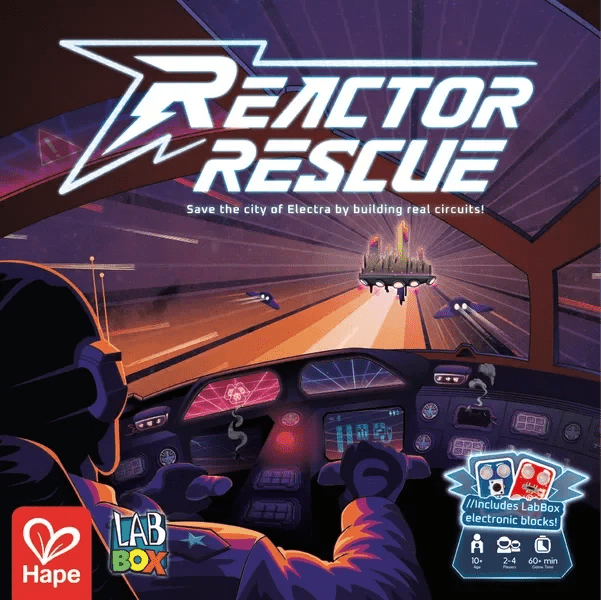
Reactor Rescue | 2026 Analog Game Winner
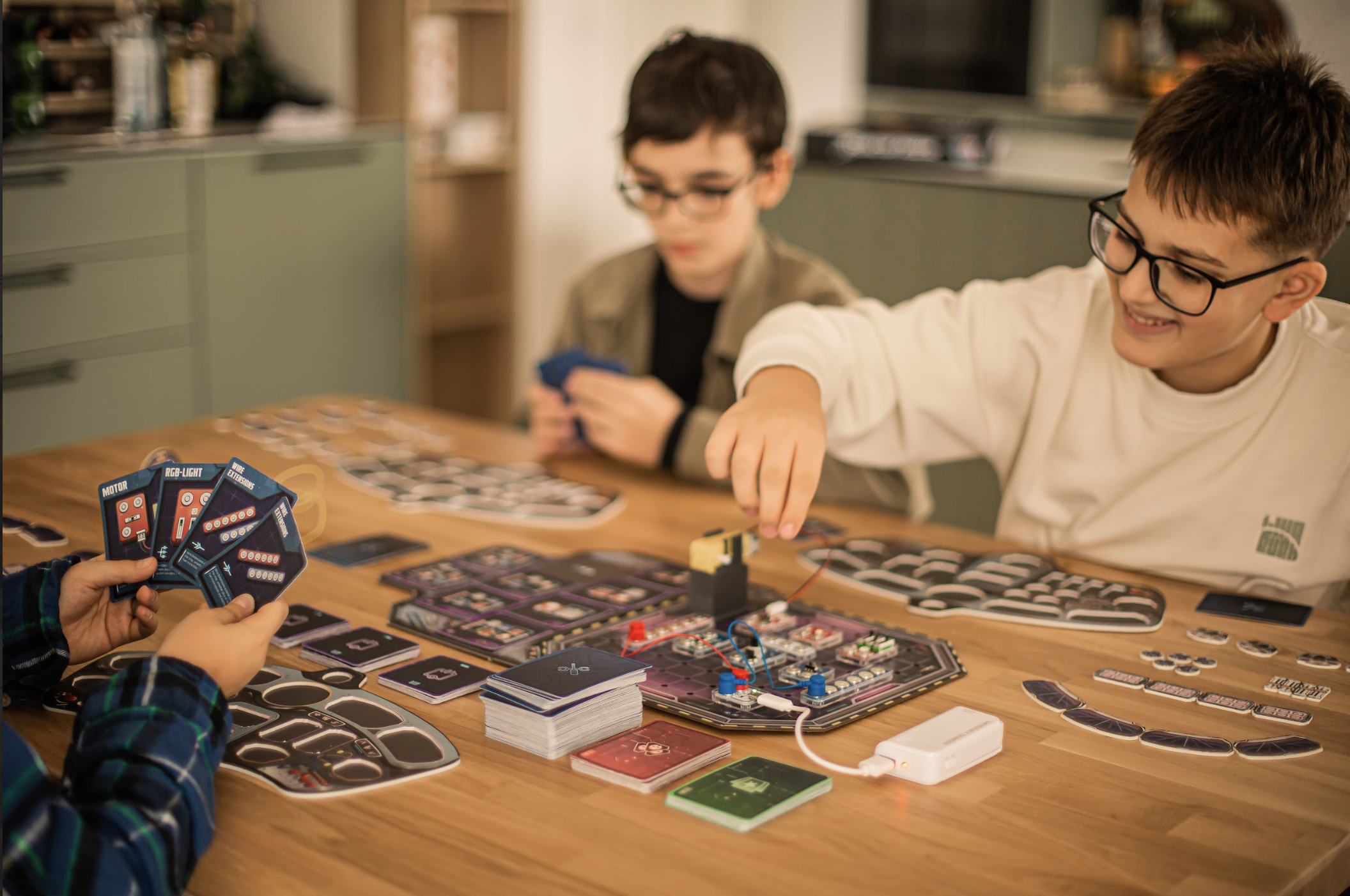
Judging the analog category alongside other digital educational games attunes you to the specificity of what physical games can bring to the table. Analog games have a number of general strengths: they don’t become unusable because of an OS update, they bring people face to face with one another, and they are relatively easy to mod for different uses. Sometimes, though, there is a game that leans more heavily into the affordances of its physicality, drawing in players with the kinesthetic and tactile joys of touch. Reactor Rescue is just such a game. At its core, Reactor Rescue is a game about building circuits. The board contains several components: a switch, a dial, a motion sensor, a color light, a bulb, a motor, and a power supply. Players are tasked with building simple circuits by connecting the positive and negative terminals with wires that snap magnetically (and satisfyingly) into place. On their turn, a player selects a card with a target circuit to build and has two minutes to connect things properly. In the fiction of the game, players are at work repairing their space ships, and each success nets them some physical components to slot into a cardboard dash. The setup and gameplay are relatively simple, which is a strength given that both the complexity and the real draw of the experience reside in the circuits themselves.
Where the subtlety of the design really appears is in the way the game slowly deepens the player’s knowledge in a process that is one of the best examples of cycles of expertise that we have seen in the analog category. This is an important principle of GEE games, but one that is often easier to achieve with the responsive and quickly reactive systems of a computer. Reactor Rescue begins by giving players goal cards that show the correct wiring diagram, and moreover by giving players a free choice over the level of difficulty they will pursue while wiring. This allows newcomers to master basic ideas, such as the fact that circuits need to make a closed loop, that one must attend to the polarities of the terminals, and to teach what each of the input and output components do. Additionally, the components themselves come with simple troubleshooting elements built in, so that the player always has immediate feedback on their actions. Once players master the most complex arrangement of wiring, they can then move onto a second deck, which only shows the components. This moves players up a qualitative level, no longer focusing on the meaning of the wires, but on the larger principles of how elements should be connected to achieve the desired effect. Again, there are multiple levels of difficulty within these target cards. Finally, there are instructions for a free-exploration mode. While the time pressure of trying to complete circuits in two minutes may make it hard to casually explore for a deeper understanding, the solo module allows interested students to go further, and engage in sandbox style play.
Overall it is the partnership of this elegant learning design with the toyful fun of physically manipulating electricity that makes Reactor Rescue our GEE winner.
Lead Judge: Peter McDonald
Judges: Yasamin Zamanieh, Gaby Sanchez, Eda Zhang, Ryan Lay, Yunseo Lee, Val Hammer