Elfie: A Sand Plan: 2026 Small/Indie Game Winner
STUDIO/WEB: https://pressedelephant.com/
STEAM: https://store.steampowered.com/app/3784760/Elfie_A_Sand_Plan/
Sandcastles never seem to stay together for long. They have to obey the laws of physics, the sea, and the waves. That makes a sandcastle a good candidate for simulation, for being built in software instead of wet sand, especially when it's coaxed along by Elfie, a bobbing, pixelated elephant. At its core, Elfie: A Sand Plan is a series of spatial-relation puzzles, where players translate flattened one- and two-dimensional projections into sandcastles made of boxes, cones, and steps, often creating impossible shapes. It's as much a cozy narrative as a puzzle: a good part of players' time is spent with Elfie, who chatters at them in dialogue boxes, in the gentle manner of a visual novel.
The game gives players the role of a peer, co-building alongside Elfie herself. Players manipulate their own little world, rotating, sliding, and elevating blocks, and there are often a lot of possible solutions that fit the geometric constraints. In that freedom, Elfie supports empowered learners. The exercise at the heart of it stays simple and steady: read one or more of the different front, side, and top views, and make something that's true for all of them at once. The game is deliberately peaceful, often with more than one correct answer, and free of timers or pressure. As rewards, players unlock a wardrobe of swimsuits for Elfie, who lights up at each one.
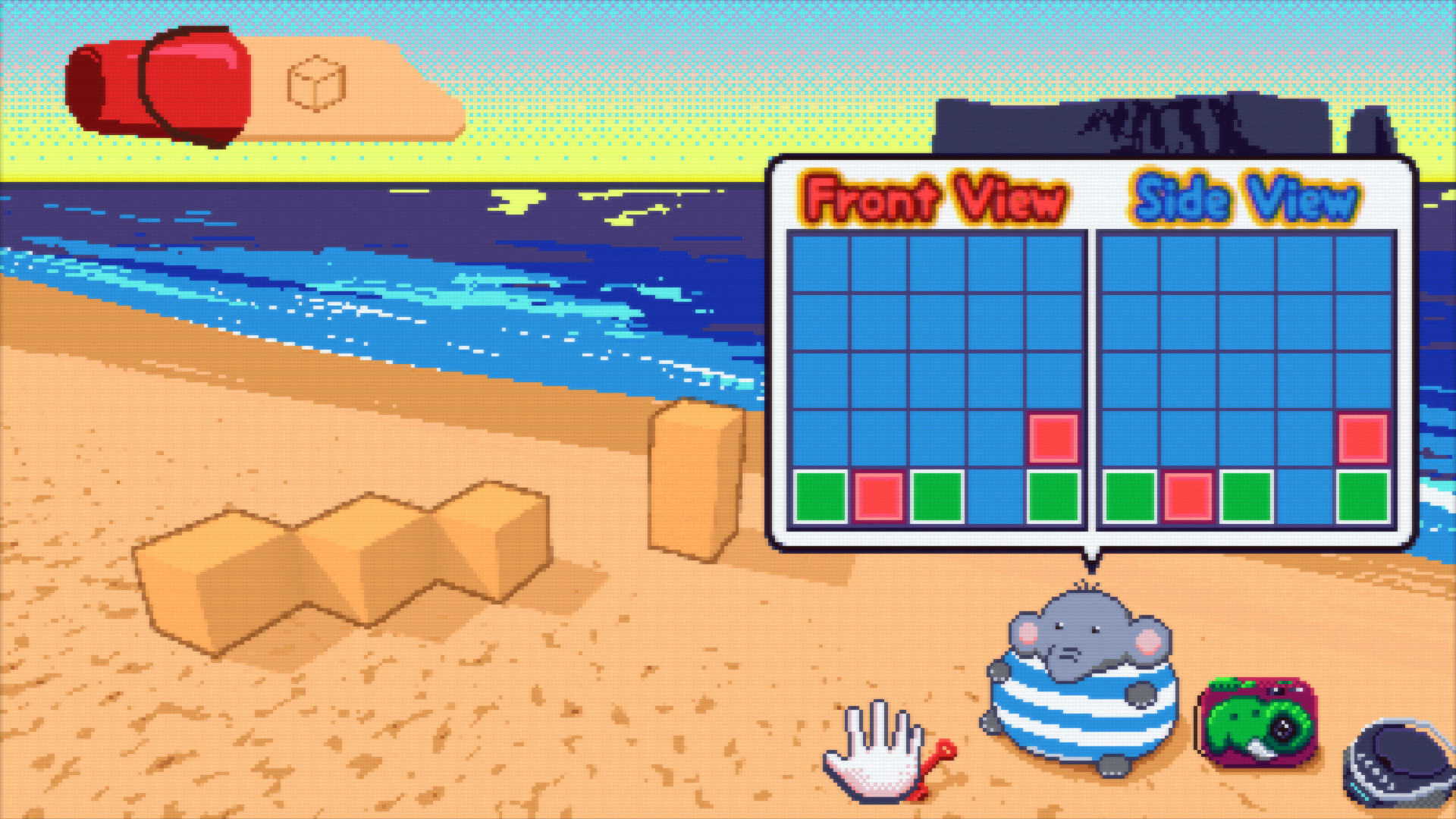
Elfie's design is well-ordered, with an onboarding that builds the skills in a reasonable progression: first position, then stacking, then rotation, then the turn from front view to side view, each step a harder skill. It scaffolds these mechanics carefully and even prompts players to take breaks in the right places: after a new mechanic, or after a few castles. As problem-based learning, it's well-judged: the easy levels can be treated naively as 2D, but the game quickly becomes 3D, with a real spatial aspect. It's pleasantly frustrating, mostly in the productive ambiguity of how to fulfill the blueprint, where players have to cognitively reorient to build it right, with color feedback and just-in-time nudges along the way.
We rarely have a reason to think about projections at all; our brains naturally assume that when we see something, we know its whole form. Elfie is a little like a certain kind of artwork, the sort where a piece looks like a familiar object from one direction, a face or a bird, and from another breaks into a jumble of unrelated parts, because players couldn't see how they were stacked (Markus Raetz and Shigeo Fukuda both make work like this). Here, meaning is action: on every move, players synthesize the 2D plan into the 3D build. What Elfie leaves players with, in the end, is a deeper understanding, an intuitive sense that what we see is never the whole view, a "don't trust what you see" idea, played out in practice. Indirectly, it's a way to intuit both the guidance and the limits of an engineering drawing, or even a medical scan.
This cozy elephant at the beach is a lighthearted, spatial-relation narrative game, suitable for a broad range of players, across many languages, with a gentle vintage dither look. Congratulations to this year’s Small/Indie category winner, Pressed Elephant: almost without players noticing, Elfie builds the quiet skill of holding a shape in mind and turning it, a stealth spatial-reasoning trainer that, by the end, has players seeing the solid world from sides they were never shown.
—
Thanks to category lead Michael Douma (IDEA Games), and judges Matheus Cezarotto (New Mexico State University) and Al Olsen (NYU CREATE Lab).